
What My Students Understood Before the Country Did
Watching the new documentary, Ask E. Jean, and Reflecting on a Movement Still Unfolding

Merriam-Webster’s dictionary announced that “feminism” was the most searched word in 2017 during the height of the #MeToo movement. At the time, it felt as though the country was finally beginning to confront realities that many women, especially young women, had long understood intimately: sexual harassment, abuse, unequal power structures, and the normalization of misogyny were not isolated incidents. They were systemic.
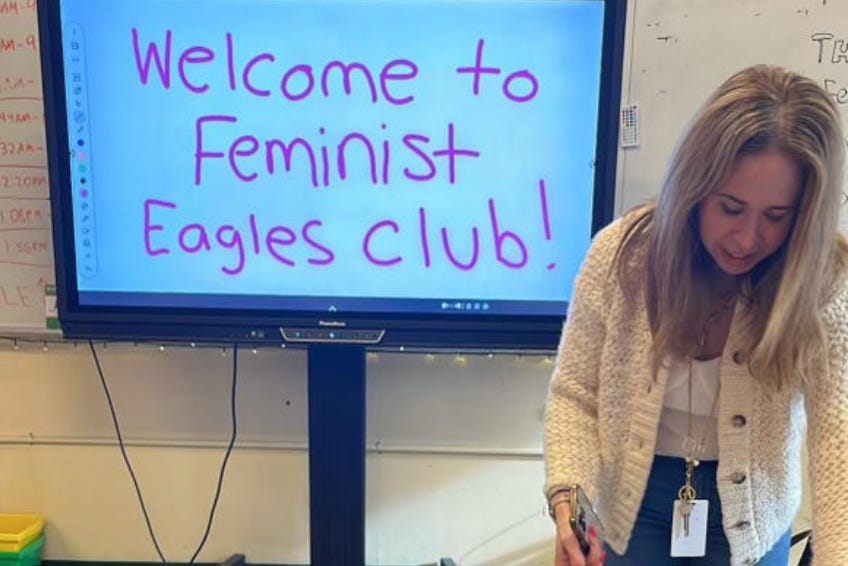
Nearly a decade later, I keep thinking about the students in my high school feminist club, the Feminist Eagles, and the conversations we were having years before many adults were willing to publicly engage with these issues.
Long before #MeToo became a hashtag recognized around the world, students in our club were discussing consent, toxic masculinity, catcalling, rape culture, intersectionality, and the ways power protected certain people while silencing others. At the time, some students were even nervous about publicly identifying themselves as feminists because they feared backlash from their peers.
Now those same conversations dominate headlines, political debates, documentaries, podcasts, courtrooms, and social media feeds.
This week, I attended a screening of Ask E. Jean, a documentary by Ivy Meeropol, about E. Jean Carroll. Watching Carroll’s story unfold onscreen was overwhelming, inspiring, enraging, and clarifying all at once.
As most people know by now, Carroll became the first woman to successfully defeat Donald Trump in court, twice. In a society where powerful men have historically operated with near impunity, that matters.
Not because one legal case suddenly dismantles patriarchy or fixes systemic injustice, but because moments like this force the country to publicly grapple with questions many women have been asking privately for generations.
Who gets believed?
Who gets protected?
Who gets silenced?
Who gets punished?
These are not simply gender questions. They are civic questions.
At the same time, the renewed public conversations surrounding Jeffrey Epstein and the broader network of wealthy and politically connected men tied to abuse allegations have once again exposed how power often functions in America. People are not simply horrified by the crimes themselves. They are horrified by the perception that institutions repeatedly shield wealthy, famous, and politically connected individuals from accountability.
For many women, none of this feels particularly new.
The Feminist Eagles had been discussing these power structures years ago through the lens of their own experiences navigating schools, workplaces, relationships, social media, and public spaces as young women. What often starts as “small” experiences of harassment or objectification teaches girls very early how power operates in society.
One of the most striking things about the #MeToo movement was how many women realized they were not alone once others started publicly sharing their experiences. From the personal came a collective movement.
That dynamic feels deeply connected to what I witnessed firsthand in the Feminist Eagles.
At first, many meetings revolved around students sharing deeply personal experiences and frustrations. Some students worried we had turned into a support group instead of an activist organization. But in retrospect, that communal sharing was part of the political awakening itself. Once students realized their experiences were systemic rather than isolated, they became far more interested in activism, organizing, and changing the broader culture around them.
As a teacher, I still see young people trying to process all of this in real time.
I see young women who are far more willing to name sexism, coercion, manipulation, and abuse than previous generations were at their age. I also see young men wrestling with changing expectations around masculinity, consent, and power in ways that are often uncomfortable, but necessary.
And increasingly, I see students understanding that these issues are deeply interconnected with broader questions about democracy and institutional trust.
Social movements are never linear. Progress tends to come in waves, followed by backlash, exhaustion, and attempts to reassert old power structures. The #MeToo movement did not solve sexism. A courtroom victory does not erase decades of institutional protection for abusive men. Nor does public awareness automatically produce justice.
But movements matter because they shift what society is willing to tolerate publicly.
And that shift is real.
When I look back at the Feminist Eagles now, I realize those students were not simply reacting to a political moment. In many ways, they were anticipating one.
As adults, we still have much to learn from younger generations. Their willingness to openly challenge entrenched systems, discuss uncomfortable realities, and reject silence continues to shape the national conversation.
Watching E. Jean Carroll’s story this week reminded me that history does move, even when it feels painfully slow.
And perhaps more importantly, it reminded me that meaningful social change has always been intergenerational and community-based. Change does not happen because one person saves society. It happens because countless people speak up, organize, teach, protest, write, support one another, and refuse to quietly accept injustice as inevitable.
That is what I saw evolve almost ten years ago in our Feminist Eagles club.
And despite everything, it is what still gives me hope today.
Interestingly, this year students chose to rename the Feminist Eagles the “Activist Eagles.” In many ways, that evolution reflects the broader shift I have witnessed among younger generations. While feminism remains central to many students’ political identities, they increasingly see struggles around gender, race, democracy, climate, American foreign policy decisions, economic inequality, gun violence, and LGBTQ rights as deeply interconnected rather than separate causes. The language changed, but the underlying mission, challenging unequal power structures and fighting for a more just society, remained remarkably consistent.
You can follow E. Jean Carroll on Substack!
AND
here are some other articles I’ve written about the Feminist Eagles
Women’s History Month Reflection: The Vital Importance of the Feminist Club at Our School
Creating Meaningful Connections With School Clubs, Even During Online Learning
Maybe get E Jean on Yo Miss for a video interview? Induct her into the Activist Eagle Hall of Fame? I read her book and she’s a true champion for women.