

What Florida Gets Wrong Again About History Education


As someone who has taught AP U.S. History in a NYC public school classroom for over two decades, I actually agree that we need to rethink how we teach American history in this country. But what Florida is doing is not educational innovation. It’s ideological revisionism dressed up as reform.
The issue has never been that students are learning “too much” about racism, inequality, or injustice. If anything, too many students leave history class seeing the past as a timeline of disconnected trivia instead of something actively shaping the world around them right now.
We should be teaching more modern history and making more connections between past and present. Students should understand how Reconstruction connects to voter suppression debates today. How propaganda spreads. How conspiracy theories flourish during moments of economic instability. How democracies weaken slowly over time while ordinary people convince themselves it could never happen here.
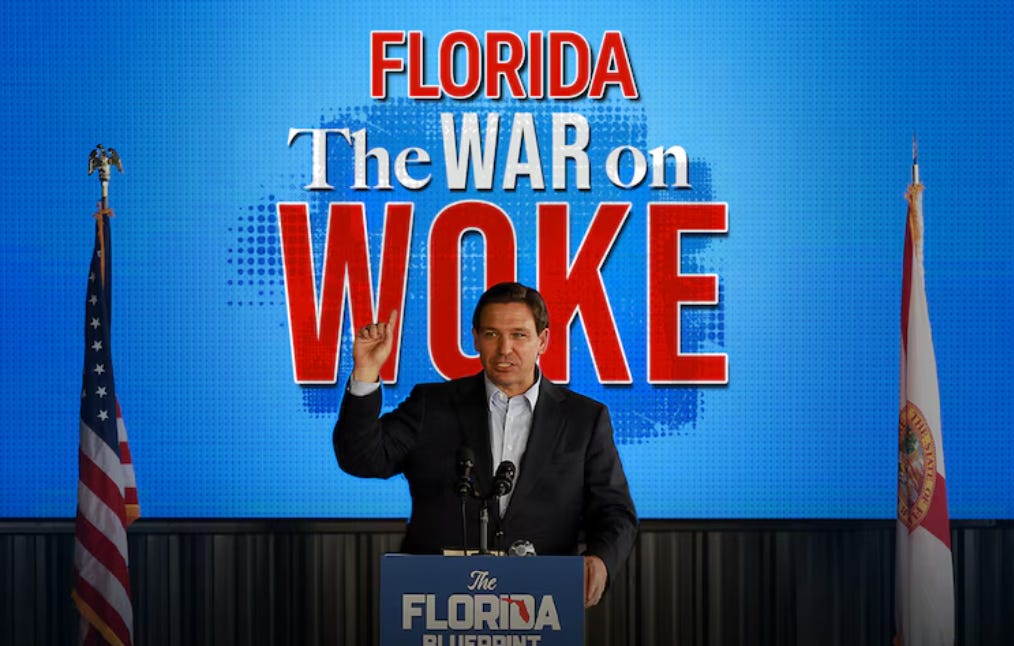
Instead, Florida is now creating an explicitly conservative alternative to AP U.S. History through its new FACT program: the Florida Advanced Courses and Tests framework. State officials are openly framing it as an answer to what they claim is “woke ideology,” DEI, and Critical Race Theory supposedly embedded in AP courses. (Spoiler: It is not.)
And honestly, that should concern people regardless of political ideology.
Because history education should not exist to protect students from discomfort or complexity. It should help them analyze evidence, wrestle with contradictions, recognize patterns, and understand how power actually functions in a democracy.
One of the most infamous examples from Florida’s recent standards was the claim that enslaved people “developed skills which, in some instances, could be applied for their personal benefit.” And now the new FACT framework reportedly describes the Constitution as fundamentally antislavery while emphasizing “Western civilization,” patriotic education, and a more sanitized narrative of American development. The recommended textbook, Wilfred McClay’s Land of Hope, has been promoted as an “antidote” to Howard Zinn’s A People’s History of the United States.
Slavery was never a résumé builder. It was a violent system rooted in white supremacy and capitalism. It built enormous wealth in this country through forced labor, terror, exploitation, family separation, and dehumanization.
What concerns me most is the climate these curriculum battles create for teachers and students. The message becomes: avoid complexity, avoid discomfort, avoid connecting the past too directly to the present, avoid confronting the contradictions of American history in order to move closer to the ideals of a multiracial and inclusive democracy.
But history is complicated. Democracy is complicated.
If students aren’t deeply studying Reconstruction, Jim Crow, redlining, the Civil Rights Movement, political violence, media manipulation, and democratic backsliding, then how can they possibly make sense of the America they’re inheriting?
Historian Timothy Snyder writes about this in On Tyranny and in his work on the “history wars.” One of the recurring themes in authoritarian and totalitarian societies is the attempt to replace complicated history with patriotic mythology.
Because critical thinking is dangerous to authoritarian rule.
And no, that does not mean America is Nazi Germany. People online flatten history way too easily. But history absolutely shows recurring patterns: attacks on educators, fear mongering about “dangerous ideas,” political control over curriculum, pressure to teach nationalism over nuance, and attempts to turn education into ideological loyalty training instead of critical inquiry.
Real history is complicated. America is complicated. Democracy is complicated.
And honestly, young people can handle that complexity far better than many adults give them credit for.
My students are already growing up in a world shaped by AI, algorithms, disinformation, political extremism, economic inequality, climate anxiety, and nonstop media manipulation. Pretending history is just memorizing presidents and dates while avoiding modern relevance does not prepare them to be informed citizens. And young people see right through a curriculum that undermines their intelligence by sugarcoating the past.
History class should help students recognize patterns, challenge misinformation, ask hard questions, and understand that democracy is a verb.
Because if we want young people to value and defend democracy, they need to understand how fragile it actually is.
Makes you wonder if that’s the whole point of these revisionist history curricula in the first place.
 | A guest post by
|
Well put. The MAGATs are trying to indoctrinate the youth to their bigoted revisionist theories. I believe they will fail and it will backfire. The truth always prevails. Eventually.